The landscape of national defense is undergoing a seismic transformation. No longer confined to traditional defense contractors, the Pentagon big tech Tesla Cybertruck nexus represents a fundamental shift in how military capability is conceived and acquired. This strategic pivot sees the Department of Defense actively engaging with commercial technology giants, seeking to inject innovation, agility, and disruptive thinking into its programs. At the intersection of this shift sits a uniquely controversial product: the Tesla Cybertruck. More than just an electric vehicle, the Cybertruck embodies the Silicon Valley ethos—audacious, polarizing, and built with proprietary technology that challenges conventional automotive and military standards. This article delves deep into the Pentagon’s burgeoning relationship with big tech, critically examines the potential military applications and stark limitations of the Cybertruck, and explores what this fusion means for the future of defense.
Understanding the Pentagon’s Pivot to Commercial Big Tech
For decades, the “military-industrial complex” referred to a closed ecosystem of specialized contractors. Today, that model is being upended. The Pentagon’s outreach to companies like Google, Amazon, Microsoft, and Tesla is a direct response to the rapid pace of global technological change.
The core drivers of this shift are clear:
-
Innovation Velocity: Commercial tech firms iterate at a pace unmatchable by traditional defense development cycles, which can span a decade or more.
-
AI and Computing Supremacy: The center of gravity for artificial intelligence and cloud computing talent lies in Silicon Valley, not in traditional defense firms.
-
Cost Pressures: Leveraging commercial off-the-shelf (COTS) technology, even if later modified, can significantly reduce development costs and timelines.
-
Attracting Talent: Collaboration with big tech is seen as a pathway to attracting software engineers and data scientists who might not consider a career with a legacy contractor.
However, this marriage is not without profound cultural friction. Big tech’s “move fast and break things” mentality clashes with the Pentagon’s imperative for meticulous testing, reliability, and stringent cybersecurity, often referred to as “air-gapped” systems.
Tesla’s Cybertruck: A Technical Specs Deep Dive
To assess its military potential, we must first strip away the hype and examine the Cybertruck’s tangible engineering. It is a vehicle of extremes, designed outside the norms of either the automotive or defense industries.
Key Performance Specifications (Based on Public Data):
| Feature | Specification | Military Context Consideration |
|---|---|---|
| Exoskeleton | 3mm thick, ultra-hard 30X cold-rolled stainless steel | Offers exceptional ballistic resistance to small arms fire, but is non-repairable in the field and may complicate armor-upfitting. |
| Armored Glass | Tesla Armor Glass | Demonstrated vulnerability in early tests; ultimate ballistic rating remains unproven for military fragments. |
| Powertrain | Electric, tri-motor and quad-motor variants | Provides immense, silent torque and low heat signature, but range is crippled by off-road use, towing, or auxiliary power loads. |
| Suspension | Adaptive air suspension with ~17″ of travel | Excellent for terrain adaptability and load leveling, but more complex and vulnerable to damage than heavy-duty mechanical systems. |
| Payload/Tow | Up to 2,500 lbs payload, 11,000 lbs towing | Matches or exceeds some military light truck standards, but electric range penalty under load is severe. |
| Vault (Bed) | 6 ft. length, powered tonneau cover, 120V/240V outlets | The integrated power export is a standout feature for field operations, running communications or tools. |
| Digital Network | Gigabit Ethernet architecture, steer-by-wire, 48V system | A software-defined vehicle; enables rapid feature updates but presents a massive attack surface for cyber-electronic warfare. |
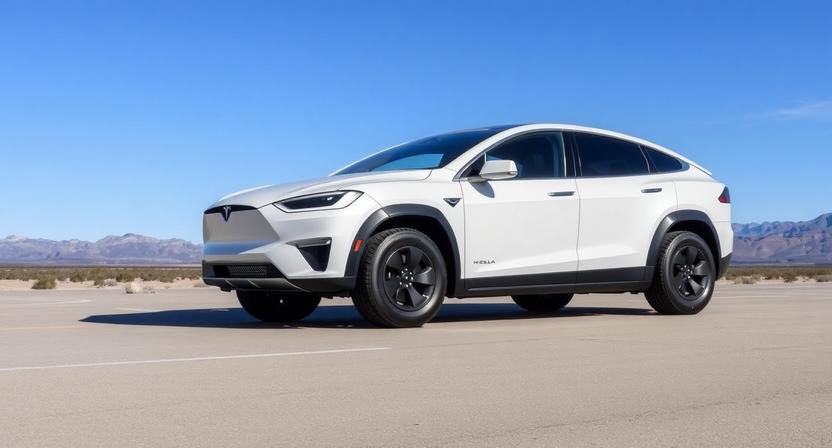
The Tesla Cybertruck’s design philosophy is inherently dual-use. Its angular exoskeleton was marketed with civilian durability in mind, yet it immediately invites comparisons to light tactical vehicles. The integrated power export is a genius feature for campers, but also for a forward operating base. This ambiguity is central to its potential military appeal.
Potential Military Use Cases for the Cybertruck
The Pentagon big tech interest isn’t about replacing the Humvee or JLTV wholesale. It’s about niche applications that leverage unique EV and tech advantages.
-
Domestic Base Security and Utility Roles: This is the lowest-hanging fruit. The Cybertruck’s durability, silent mobility for patrols, and onboard power for equipment could make it ideal for security forces on large domestic installations, reducing fuel logistics and emissions on base.
-
Special Operations Support: Small teams might value the vehicle’s unique capabilities for specific, short-duration missions. The low acoustic and thermal signature of an electric vehicle is a significant tactical advantage for insertion or surveillance near hostile areas. The vault could securely transport sensitive equipment.
-
Logistics and Light Supply in Controlled Environments: Within the secure confines of a large base or behind primary front lines, Cybertrucks could serve as efficient personnel and parts transporters, utilizing their onboard power to support maintenance teams.
-
Testbed for Technology Integration: The Pentagon may be less interested in the vehicle itself and more in its architecture. Its gigabit Ethernet backbone is a test case for integrating third-party military tech—sensors, communications jammers, or autonomous driving modules—onto a software-defined, electric platform.
The Formidable Drawbacks and Operational Hurdles
Despite the intriguing possibilities, the Cybertruck faces monumental obstacles to serious military adoption.
-
The Logistician’s Nightmare: Range and Charging. This is the single greatest flaw. A published 300+ mile range plummets under load, off-road, in extreme temperatures, or when powering equipment. Military logistics are built on JP-8 fuel, available globally. A proprietary Supercharger network is a non-starter in a contested environment. Deploying charging infrastructure to a theater of war is an absurd logistical burden compared to liquid fuel.
-
Cybersecurity Vulnerability. The Cybertruck is a computer on wheels. Its complex software, steer-by-wire system, and constant connectivity represent an unprecedented attack vector. A sophisticated adversary would target these systems relentlessly. “Hardening” it to military standards might require stripping out its very innovation.
-
Maintenance and Repair Inflexibility. The stainless steel exoskeleton is difficult to modify and impossible to repair with standard field tools. Military vehicles are designed for modular repair and up-armoring. The Cybertruck’s monolithic structure resists this philosophy. Tesla’s proprietary parts and service model is antithetical to the military’s need for organic, unit-level maintenance.
-
Tactical Limitations. Its large size, low visibility from the cockpit, and dependence on digital displays are tactical disadvantages. A flat tire or damaged suspension from a pothole could immobilize a vehicle whose systems are too complex for a soldier with a wrench to fix.
Big Picture: The Strategic Implications of the Shift
The discussion about the Pentagon big tech Tesla Cybertruck is a microcosm of a larger, more critical debate.
The potential benefits for defense are transformative: faster integration of AI, leveraging massive commercial R&D budgets, and fostering a culture of rapid prototyping. It could lead to a new generation of affordable, adaptable systems.
Yet, the risks are profound: increased reliance on a commercial sector with different ethical priorities (see Project Maven protests at Google), creating single points of failure in the supply chain, and embedding critical security systems in platforms not designed for survivability in electronic warfare.
The ultimate question is one of dependence versus leverage. Is the Pentagon leveraging commercial innovation for discrete advantages, or is it becoming dependent on a sector whose priorities are shareholder value and consumer markets, not national survival? The Cybertruck, as a product, sits at the heart of this question—it is a consumer vehicle whose design accidentally brushes against military needs, not a purpose-built defense asset.
FAQ: Addressing Key Questions on Pentagon Tech Shifts
Could the Tesla Cybertruck actually be used by the US military?
It is already being evaluated, likely for domestic, non-tactical roles like base security and utility. Its use in any forward, deployed, or combat environment is highly improbable due to its severe logistical (charging) and vulnerability (cyber) limitations. The military may study its technology more than deploy the vehicle itself.
What are the main reasons the Pentagon is turning to big tech companies?
The primary reasons are speed and talent. The Pentagon believes traditional defense contractors are too slow to innovate in software, artificial intelligence, and cyber domains. Big tech firms attract the top-tier engineering talent needed for these areas and operate at a development tempo the defense sector envies.
What are the biggest security risks of using commercial tech like Tesla’s?
The two largest risks are cybersecurity and supply chain control. Commercial platforms are not built to withstand nation-state electronic warfare attacks. Furthermore, relying on a commercial firm’s global supply chain and update servers creates vulnerabilities where an adversary could sabotage software or hardware far from the battlefield.
How does the Cybertruck compare to traditional military vehicles like the Humvee?
It’s a fundamentally different philosophy. The Humvee/JLTV is designed for ruggedness, field repairability, and logistical simplicity within a global fuel-based system. The Cybertruck is designed for consumer appeal, performance, and software integration. The Cybertruck may win on specific features (stealth, torque, onboard power), but fails on the core military tenets of reliability and supportable logistics in austere conditions.
Is this shift towards big tech a temporary trend or a permanent change?
This is a permanent, structural change in defense acquisition. The technology gap between commercial and military sectors in AI, computing, and autonomy is too wide to ignore. The Pentagon will continue to build deeper, albeit often fraught, relationships with big tech, leading to a new hybrid defense-industrial base.
Conclusion and Key Takeaways
The exploration of the Pentagon big tech Tesla Cybertruck dynamic reveals a defense sector at a crossroads. The Cybertruck itself is unlikely to become a common sight on battlefields. Its value lies as a symbol and a case study—a provocative example of the kind of disruptive, dual-use technology that is forcing the world’s most powerful military to rethink its partnerships and processes.
The Pentagon’s engagement with Tesla and other big tech firms is not a fad; it is a necessary, risky, and inevitable adaptation to a world where software defines capability. The challenge ahead is to harness this innovation without compromising the unforgiving requirements of security, survivability, and logistical sanity that define military operations.
Actionable Insights:
-
Think in Terms of Capabilities, Not Platforms: The military should focus on acquiring specific tech capabilities from big tech (e.g., AI algorithms, sensor fusion software) and integrating them into purpose-built, hardened military systems, rather than adopting consumer platforms wholesale.
-
Develop New Testing Standards: The Pentagon must urgently create robust testing frameworks for cybersecurity and electronic warfare resilience for any commercial technology intended for tactical use.
-
Invest in Dual-Use Logistics: If electric tactical vehicles are ever to be viable, the DoD must invest in resilient, renewable energy generation and storage at the unit level, reducing the burden of a centralized charging grid.
-
Bridging the Culture Gap: Success requires building permanent liaison and translation teams between the Pentagon and Silicon Valley to align the “move fast” ethos with the “assure never fails” mandate.
The road ahead is complex. The ultimate success of the Pentagon’s big tech gambit will be measured not by flashy prototypes, but by the seamless, secure, and supportable integration of Silicon Valley’s genius into the defender’s toolkit.